

How Is Animal Agriculture Bad For The Environment
Why is animal agriculture bad for the surroundings?
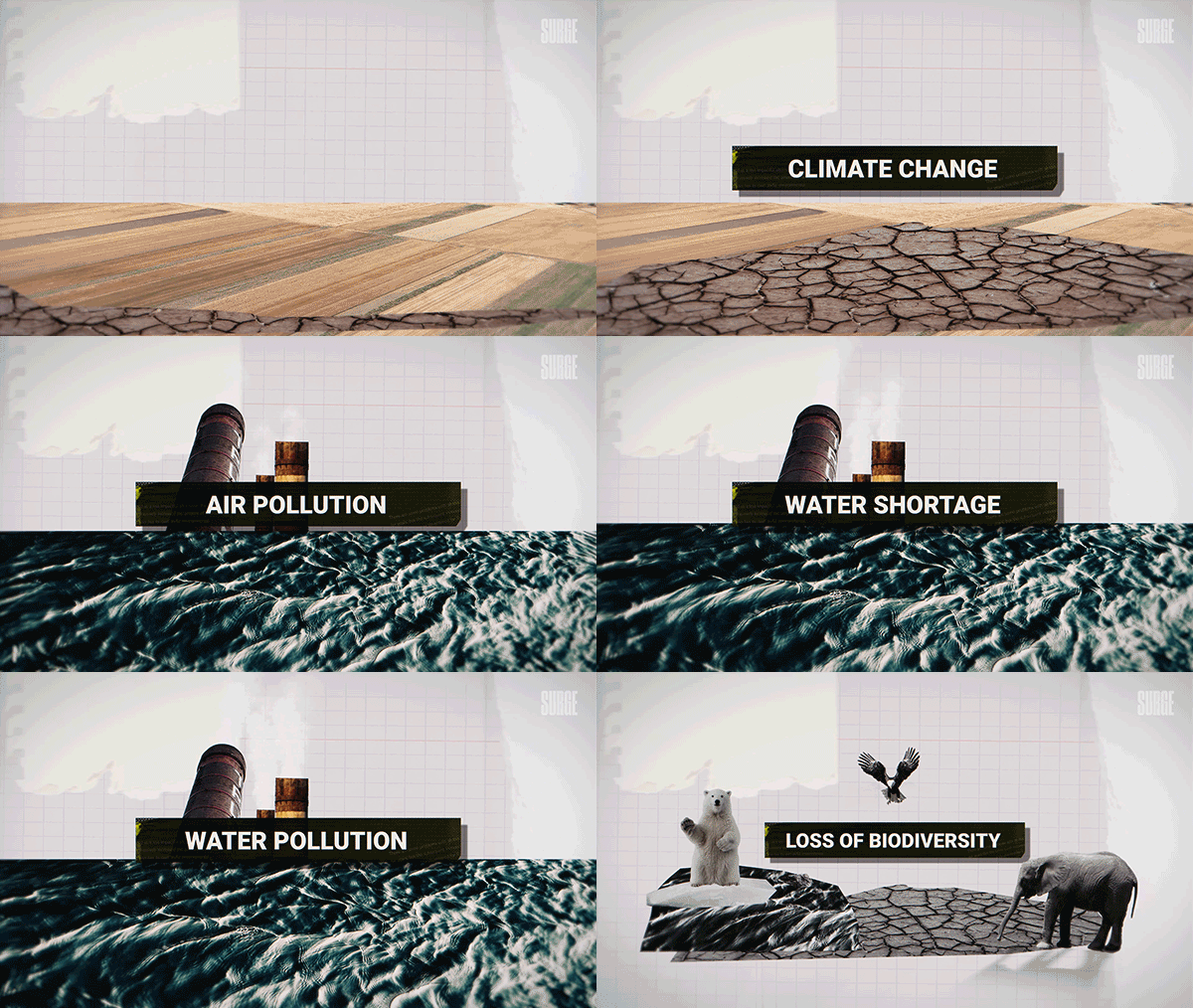
In 2006, the United Nations stated[ane]:
"The livestock sector emerges every bit ane of the superlative ii or three about meaning contributors to the near serious environmental issues, at every scale from local to global. The findings of this written report propose that it should be a major policy focus when dealing with problems of land degradation, climate change and air pollution, water shortage and water pollution, and loss of biodiversity."
And so four years after, they warned that a global shift towards a vegan diet is vital to save the globe from hunger, fuel poverty and the worst impacts of climate modify.[2]
So why exactly is animal farming bad for the environment?
Globally, 26 per cent of all the world's ice-free state[3] surface is given to grazing animals and in total animal agriculture uses 83 per cent of all agronomical land[4], yet it provides less than 20 per cent of the calories consumed and less than forty per cent of the protein[5] that is consumed.
In the UK, it is estimated that 85 per cent[6] of the land that is used for agronomics is but for animals, which is almost fifty per cent of the entire landmass of the UK.[seven] And in the U.s.a., 41 per cent of the entire landmass is for animal farming compared to four per cent[8] which is used to grow plants directly for humans, with one-half of all agricultural land in the US being used specifically for beef production even though it makes upwards only three per cent of dietary calories.[ix]
![Globally, 26 per cent of all the world's ice-free land[3] surface is given to grazing animals and in total animal agriculture uses 83 per cent of all agricultural land[4], yet it provides less than 20 per cent of the calories consumed and less than …](https://images.squarespace-cdn.com/content/v1/5d822de98eca3f604cff69f2/1621867534749-BSA06PKNFNRBJUPEF7MX/image-asset.gif)
Beast farming is the leading cause of rainforest deforestation[x], the single largest driver of habitat loss[11] in general and agriculture, which besides includes the farming of fish, is listed every bit being a threat to 24,000 of the 28,000 species[12] that are currently facing extinction.
And when it comes to the Amazon specifically, cow ranching is reportedly responsible for 80 per cent of rainforest loss in the Brazilian Amazon[thirteen], with a recent investigation by the Agency of Investigative Journalism showing that in 2019, fires in the Amazon were three times more mutual[14] in areas where there is cattle ranching. When information technology comes to soy, it is estimated that around 90 per cent of all of the soy that is produced in Brazil is used as animal feed, and globally 75 per cent of all the soy[xv] that is produced is used for animal feed, with only 6 per cent of whole soybeans that are produced being used to produce plant-based products like tofu, soy milk and establish-based alternatives.
As for emissions, a Academy of Oxford report stated that even if the use of fossil fuel was ended immediately, the emissions produced by the agricultural sector[sixteen] alone would make information technology incommunicable to limit warming to 1.v degrees celsius and would fifty-fifty make it difficult to not hit two degrees. This means changes to our food system are essential if nosotros want to avoid making the coral reefs disappear, creating more extreme heatwaves, water scarcities, droughts and food shortages for hundreds of millions more than people, forcing them to exist climate refugees. It is as well vital if nosotros want to avert the continuing demise of the world'southward biodiversity, increasing rates of dead zones and species extinction and the rise of ocean levels causing the flooding of major cities such as Mumbai, Shanghai, Miami and New York and the potential for islands in the Southward Pacific ocean to disappear completely.
Brute agriculture is responsible for producing betwixt 14.5 and 18 per cent[17] of total greenhouse gas emissions (GHG), which makes it responsible for more emissions than the combined exhausts of all transport globally. The fishing method of bottom trawling alone is responsible for producing the aforementioned amount of emissions equally the unabridged aviation industry.[18]
![Animal agriculture is responsible for producing between 14.5 and 18 per cent[17] of total greenhouse gas emissions (GHG), which makes it responsible for more emissions than the combined exhausts of all transport globally. The fishing method of botto…](https://images.squarespace-cdn.com/content/v1/5d822de98eca3f604cff69f2/1621868358590-USRAC2OD9D1DRFTW73WC/image-asset.gif)
Switching to a plant-based diet tin can reduce agricultural emissions by as much as 73 per cent[19] in loftier-income nations and a study, published in the journal Science of The Total Surroundings, that analysed 313 dissimilar potential food systems[20] discovered that the highest GHG emissions were plant in the food systems that included a high meat demand, peculiarly if focused on ruminant meat and milk, and the lowest emissions were from the vegan diets.
Simply what most local fauna products? Are they non more than sustainable than ownership plant foods from abroad? Well not co-ordinate to the science, in fact when it comes to beef simply around 0.5 per cent of the emissions[21] come from transportation and for lamb information technology is simply two per cent, meaning that the issue of animal farming is the farming itself. Even with plant foods similar avocados, but viii per cent of the total footprint comes from the travelling itself - indeed for nearly food products the transportation accounts for less than 10 per cent, with the higher transportation percentage simply being a reflection of the fact the nutrient naturally produces lower amounts of greenhouse gases.
Furthermore, a report comparing greenhouse gas emissions[22] from the average nutrition beyond countries in the Eu revealed that transportation was only responsible for six per cent of the full emissions related to diet, and when the results were broken downwards past food items, animal products were shown to exist responsible for 83 per cent of emissions in the average Eu nutrition, compared to just 17 per cent coming from institute-based foods.
In the United states, the climate impacts of food choice were analysed[23] and nutrient ship was shown to merely business relationship for five per cent of emissions in the average The states household, which equals effectually 0.four tons of CO2 equivalent. Nevertheless, the study showed that substituting calories from scarlet meat and dairy to plant-based alternatives for just 1 day a week would salve 0.46 tons of CO2 equivalent, meaning that eating plant-based over ruddy meat and dairy just one day a week would achieve the aforementioned event as having a diet with zilch food miles.
The just mode that buying local animal products could be more sustainable is if, to begin with, the farming of different foods was the same environmentally with the only divergence being the miles the 2 foods had to travel. This is plain non the example.
Only isn't regenerative beef proficient for the environment because grazing cattle can blot carbon dorsum into the soils? Non according to the meta-analyses that have been conducted on the matter. Grazed and Confused, a report past researchers based at the Academy of Oxford, states that although sure grazing managements can put carbon into the soil, at all-time this would merely corporeality to 20-60 per cent of the emissions that the animals produce in the first place.[24]
After a few decades, the soil reaches soil carbon equilibrium likewise, meaning the soil cannot sequester any more carbon. At which indicate none of the emissions from the animals would be beginning. And so farmers would either accept to start grazing on more country, increasing the state used for animate being farming, or stop the farming - meaning that grazing animals is not an effective short term or long term strategy for dealing with the trouble either.
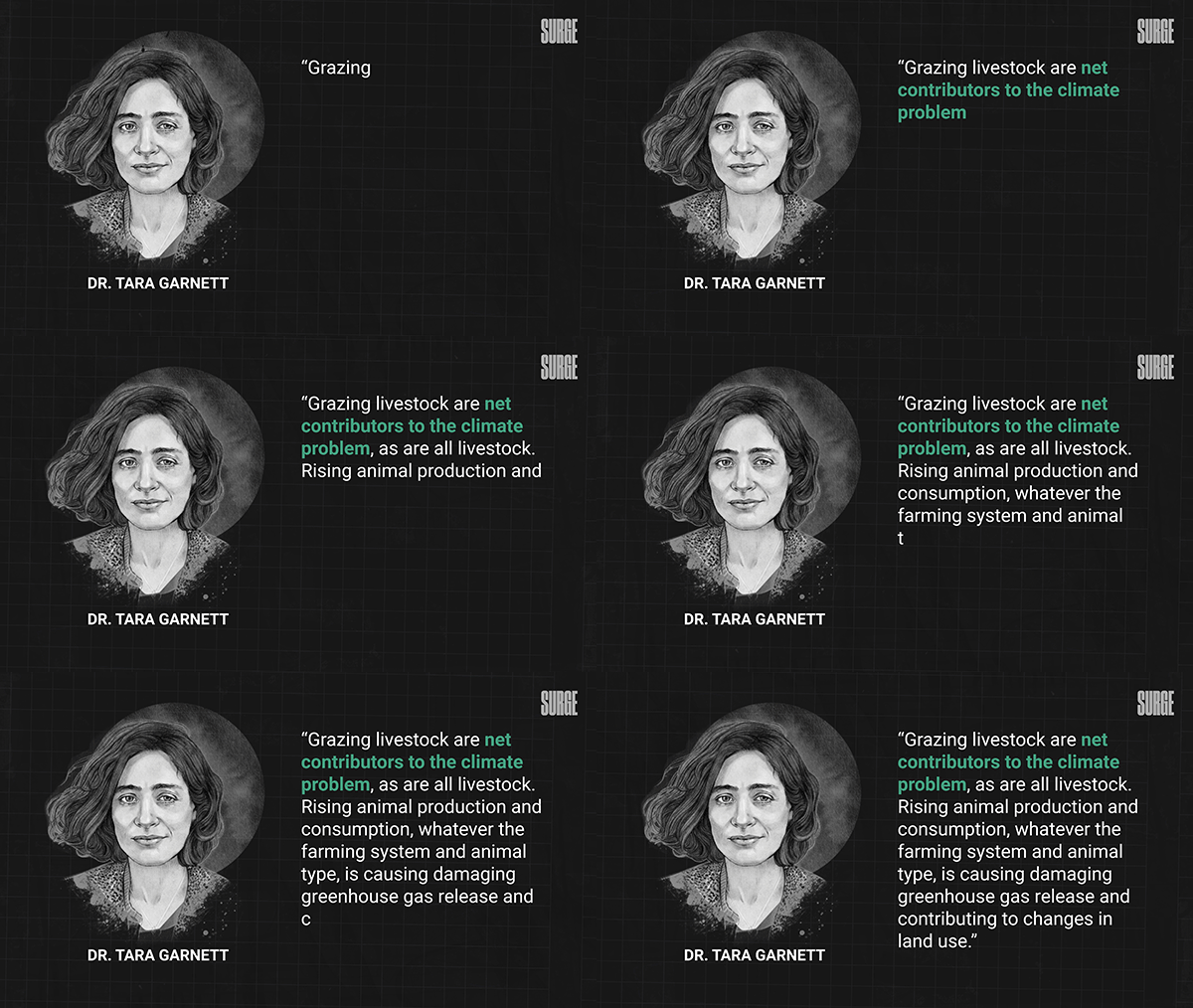
In the words of 1 of the atomic number 82 researchers of Grazed and Confused, Dr Tara Garnett of the University of Oxford: "Grazing livestock are net contributors to the climate problem, as are all livestock. Rising fauna production and consumption, whatever the farming system and animal type, is causing dissentious greenhouse gas release and contributing to changes in country apply."
Even the lowest touch beef[25] is responsible for six times more greenhouse gases and a staggering thirty-half-dozen times more land than plant proteins such as peas.
Plus, in that location are more benign things nosotros can exercise with the state, for example, research into the US food system found that reconfiguring cropland from animal feed to entirely human-edible crops, particularly ones that promote positive health outcomes such as fruits, vegetables and pulses, would feed an additional 350 meg people compared[26] to what the same surface area of country produces in the electric current The states food organisation.
To put that into perspective, there are effectually 330 million people in the U.s.a., meaning some other nation the size of the United states of america could exist fed with only the cropland used to currently feed animals there. Even if beef was but swapped for beans[27] in the diets of the US population, merely nether 700,000 square kilometres, which is the equivalent of 42 per cent of US cropland, would be freed up. Furthermore, in the United kingdom of great britain and northern ireland just one-third of the cropland[28] currently used to grow animal feed could provide 62 meg adults with their five servings of fruits and vegetables a day all yr which, incidentally, is almost the entire Britain population.
Plus, if the world shifted to a plant-based diet, nosotros could feed every mouth on the planet and global farmland could also be reduced by more than than 75 per cent[29], which, when put into perspective, is the equivalent size of China, Commonwealth of australia, the US and the entire European Matrimony combined no longer existence needed for agriculture. We could reforest and restore this country, bringing back lost habitats and reversing the decimation of the world's biodiversity.
![If the world shifted to a plant-based diet, we could feed every mouth on the planet and global farmland could also be reduced by more than 75 per cent[29], which, when put into perspective, is the equivalent size of China, Australia, the US and the …](https://images.squarespace-cdn.com/content/v1/5d822de98eca3f604cff69f2/1621869907093-DJR46ZJPWNU6WWMXZGSE/gif6.gif)
It is besides estimated that past returning beast farms to natural vegetation we could remove the equivalent of 8.1 billion metric tonnes of carbon dioxide[thirty] from the atmosphere each year over the form of 100 years, which is about 15 per cent of the world's total greenhouse gas emissions. Then not simply would a plant-based diet reduce full almanac emissions past around 14 per cent but it would too permit united states of america to sequester a further fifteen per cent of total annual carbon emissions on top of that.
It would too mean reducing soil acidification and eutrophication, which is the process that creates algae blooms and dead zones, by fifty per cent.[31]
All of the problems related to animal farming take come from a planet with just nether eight billion people on it. Inside the next xxx years, our population is expected to increment to x billion. Notwithstanding, global trends, as they are at present[32], are showing that animate being production consumption is increasing regardless of the growing population. This means that by 2050, the overall food need for animate being-based foods will exist seventy per cent higher and specifically ruminant meat existence 88 per cent college. For this, an additional 593 one thousand thousand hectares of land will be needed - the equivalent size of ii Indias.
Something conspicuously has to change and quickly. How much more rainforest needs to exist cut down or assault burn? Do major cities and entire islands need to exist submerged underwater? How much more than habitat needs to be destroyed and how many more species need to go extinct? How many more people need to endure from food and water scarcity?
Don't just take our discussion for information technology. The lead author of the largest and nigh comprehensive assay ever conducted analysing the impact that nutrient and agronomics has on the environment - Reducing food's environmental impacts through producers and consumers (Science, 2018) - stated in comments to the Guardian that:
"A vegan diet is probably the single biggest fashion to reduce your affect on planet Earth, non just greenhouse gases, but global acidification, eutrophication, land use and water use." [33]
It's been 11 years since the UN told us we demand to shift to a found-based diet. We don't have another decade to spare.
- ED WINTERS IS SURGE CO-FOUNDER & CO-Managing director
EARTHLINGED.ORG @EARTHLINGED
References:
-
Livestock'due south long shadow. FAO.org, 2006.
-
UN urges global move to meat and dairy-gratis diet. The Guardian, 2010.
-
Livestock'southward long shadow. FAO.org, 2006.
-
Reducing food's environmental impacts through producers and consumers. Science, 2018.
-
Reducing food'due south environmental impacts through producers and consumers. Science, 2018.
-
Total global agricultural land footprint associated with UK nutrient supply 1986–2011
-
Eating away at climate change with negative emissions. Harvard, 2019.
-
Hither's How America Uses Its Land. Bloomberg, 2018.
-
Creating a sustainable food future. World Resources Institute, 2018.
-
Cut downward forests: what are the drivers of deforestation? Our World in Data, 2021.
-
Biodiversity conservation: The key is reducing meat consumption. Science of the Full Environment, 2015.
-
What are the ecology impacts of food and agriculture? Our World in Information, 2019.
-
Controlling the Ranching Blast that Threatens the Amazon. Yale, 2009.
-
Record number of fires rage effectually Amazon farms that supply the world'southward biggest butchers. Bureau of Investigative Journalism, 2019.
-
Soy: nutrient, feed, and land use modify. TableDebates.org, 2020.
-
Global nutrient system emissions could preclude achieving the 1.5° and 2°C climate change targets. Science, 2020.
-
Global Warming: Role of Livestock. Sejian V. et al., 2015.
-
Protecting the global ocean for biodiversity, food and climate. Nature, 2021.
-
Reducing food's environmental impacts through producers and consumers. Scientific discipline, 2018.
-
Food systems in a zero-deforestation world: Dietary alter is more important than intensification for climate targets in 2050. Scientific discipline of the Full Environment, 2020.
-
Reducing food's ecology impacts throu gh producers and consumers. Science, 2018.
-
The role of merchandise in the greenhouse gas footprints of European union diets. Global Food Security, 2018.
-
Food-Miles and the Relative Climate Impacts of Food Choices in the U.s.. Environ. Sci. Technol., 2008.
-
Grazed and Confused. FCRN, 2017.
-
Reducing food's ecology impacts through producers and consumers. Science, 2018.
-
Eating abroad at climatic change with negative emissions. Harvard, 2019.
-
Nutrient organization impacts on biodiversity loss. Chatham House, 2021.
-
Eating away at climate change with negative emissions. Harvard, 2019.
-
Reducing food'southward ecology impacts through producers and consumers. Scientific discipline, 2018.
-
Reducing food'due south environmental impacts through producers and consumers. Science, 2018.
-
Reducing food's ecology impacts through producers and consumers. Science, 2018.
-
Reducing food's environmental impacts through producers and consumers. Science, 2018.
-
Avoiding meat and dairy is 'unmarried biggest fashion' to reduce your touch on Globe. The Guardian, 2018.
Your support makes a huge difference to us. Supporting Surge with a monthly or one-off donation enables us to proceed our work to terminate all beast oppression.



The Latest





Source: https://www.surgeactivism.org/aveganworld
Posted by: simpsonbeerbeen.blogspot.com
0 Response to "How Is Animal Agriculture Bad For The Environment"
Post a Comment